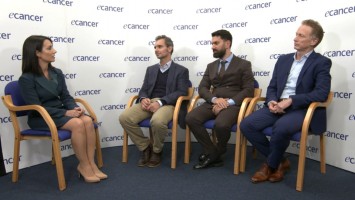
EF: Hello everyone and welcome to this ecancer initiative. My name is Enriqueta Felip, I’m a medical oncologist working in Barcelona. Today we are going to discuss the latest advances in EGFR mutated tumours presented here in Barcelona in the World Conference. So it’s a pleasure for me to share this conversation with Ignacio, with Antonio, with Alex.
IGB: My name is Ignacio Gil-Bazo, I’m a medical oncologist working at the Vithas Institute of Oncology in Spain.
AP: Hello everyone, I’m Antonio Passaro, I’m a medical oncologist working in the European Institute of Oncology in Milan, Italy.
AS: I’m Dr Alex Spira, I’m a medical oncologist with Virginia Cancer Specialists and NEXT Oncology in the United States.
EF: So, very important data presented during the World Conference. We have seen the FLAURA2 overall survival results, the same data, the MARIPOSA overall survival results are published in The New England Journal of Medicine. So, Ignacio, perhaps you can summarise the data presented by David Planchard?
IGB: I think we can say now that we have another good option for the first-line treatment of our patients with EGFR mutations. This is now probably reflecting very well that the intensification, if we can say it that way, of the treatment for the first line actually is much better than going for osimertinib alone. We’ve seen really nice results, in line with what we know from the MARIPOSA trail, for the first line in the FLAURA2. There are some still pending questions regarding, for example, the intracranial activity which is also important in our patients with EGFR mutations, but we can now say that the overall survival data are robust and clinically meaningful and, of course, much better than osimertinib alone.
EF: Yes, so probably combination is the way to go in patients with first-line EGFR mutations. Antonio, do you think there is still a role for monotherapy, what is your…?
AP: We understood and with the MARIPOSA we corroborated with the FLAURA2 that the combination is highly effective so we have a benefit here, more or less, of ten months and the expected benefit with MARIPOSA is more or less the same. But, of course, the toxicities are an issue when we combine different strategies. They’re more or less the same for FLAURA2 and MARIPOSA with a different kind of toxicity. In my opinion, monotherapy that today is clearly less effective than both the combinations will be the key for frail patients or elderly patients that in my opinion should be considered with a careful approach for the combination. But for young people affected by non-small cell lung cancer with EGFR mutant disease I think the combination should be at least discussed to consider in the clinical setting because the benefit in overall survival is huge.
EF: So we have two options in first line, two combinations that improve survival. What could be the key factors to decide one or the other one, Alex?
AS: I don’t think we have enough time to talk about all the key factors here. It’s complicated. First and foremost every physician is going to have a different opinion because the data is very similar and we cannot argue with either one of the choices. There’s something to be said for a chemotherapy-free regimen – MARIPOSA no chemotherapy – which theoretically sounds great, patients love that. We have emerging data that shows that you’re not developing the same resistance mutations. But, by the same token, chemotherapy with osimertinib is well tolerated and there’s no rash, so there are different side effects there. Obviously you have issues with frequency of dosing and subcutaneous, which we’ll talk a little bit about with some of the other studies, so it’s complicated. I think every physician is going to have their opinion, I think the field is going to divide up. In my opinion it’s going to be some will give FLAURA2, some will give MARIPOSA and I think many people will still get osimertinib. It’s hard to argue with such a well-tolerated oral regimen where, yes, there’s overall survival but the quality of life is so much better. So teasing that out with the right patient is probably what’s going to happen with what we always call shared decision making.
EF: Yes, I agree, but excellent news that we have now combinations, two combinations, that improve overall survival and osimertinib is doing exactly the same in all the trials with a median overall survival of 31-36 months. In the same plenary session we have seen the results of the HARMONi, the ivonescimab data in second line. Antonio, could you summarise and perhaps put it into context?
AP: I think that the HARMONi trial is a very interesting trial evaluating the ivonescimab. Ivonescimab, a B-specific antibody mixed between immune checkpoint inhibitors and bevacizumab, an anti-VEGF, is a very interesting molecule. This kind of study was combined with the standard chemotherapy, randomised with the chemotherapy alone, for patients progressing after third-generation TKI. Data are clearly positive considering the progression free survival but the overall survival shows only a trend in favour of this combination. This is a big limitation considering the potential approval from the FDA, also from EMA, for this kind of study that previously had a similar trial in China only for patients with these kinds of characteristics with more or less the same results. Considering the safety profile, ivo plus chemo appeared very well tolerated compared to the chemotherapy alone without any major issue considering safety. But efficacy today is a limitation to consider [??] time this kind of drug in the clinical setting.
EF: Do you think, Ignacio, that overall survival should be the endpoint in these trials in second line or there is still some room for PFS data?
IGB: I think PFS is still a very good endpoint when we are considering this type of clinical trial. It is clinically meaningful for the patients too. Of course we, as medical oncologists, tend always to look at the overall survival as the ultimate endpoint in any clinical trial. But I think we have to accommodate that to the reality of the setting in which we are practising. So still I think it’s a valid endpoint. Probably here the problem that I see is that when introducing the non-Asian population we’ve been witnessing not that good results that we saw before for the Chinese population alone. So I think this is something that we’ve seen in many other clinical trials and we have to be cautious about the results.
EF: Antonio, you mentioned ivonescimab is an anti-PD-1/anti-VEGF bispecific and one of the comments of the discussion was that perhaps activity in the study is more for the anti-VEGF activity of the agent instead of the anti-PD-1. Alex, do you share this?
AS: Yes, I do. This is not the first go-around with the VEGF. We’ve heard a tonne of data with bevacizumab over the years as well as some small molecules. They’ve always kind of showed a little bit of a trend in improvement but never quite get above the finish line but people are really using it, leading to FDA approval. So to me there’s no surprises here. Ivonescimab is this drug that, to me, came out of nowhere a few years ago in the wildtype population and there was huge excitement. And every time we’ve seen a little bit of a let-down there. So it’s a little disappointing because we were all very excited by it and it was really going to invoke a change, so I wonder where this drug is going to go. But without an overall survival, without a target there for a drug, although it’s mild it still has some side effects – there’s hypertension, concern with bleeding as well. I wonder where it’s going to go and I think if we knew more about the structure and is it truly VEGF and is the PDL just completely not needed, which I think is the case, as you mentioned, I think we’re going to struggle to where this drug is going to go.
EF: Another study that was presented here in Barceolona is the COMPEL trial analysing if we should keep osimertinib at osimertinib progression in a selected group of patients with EGFR. I think this, perhaps, there are some differences between the United States and Europe. We used to give only chemotherapy in this scenario but a lot of American colleagues maintained osimertinib to disease progression. What would be your reactions about the COMPEL study? Should we maintain osimertinib in those patients who are receiving a monotherapy when they progress or not? Ignacio?
IGB: I think there is a clear biological rationale for keeping osimertinib. We know probably there are many tumour cell clones that are still sensitive to the TKI, to the EGFR blockade, so it really makes a lot of sense for me to combine and to keep osimertinib and on top of that add chemotherapy. The results are actually good and show this prolonged benefit for those patients. Especially I think it is important for those practices or countries in which no other drugs are available. If you have amivantamab access in your country maybe you can consider MARIPOSA-2 at the time of progression to osimertinib alone but when you don’t have that access maybe this is a very good thing to do, just to keep osimertinib and add chemotherapy.
EF: Alex, your…?
AS: Yes, I agree completely. There’s a huge scientific rationale – either suppressing clones or brain metastases, we all know that that works. It’s been used off-label very commonly in the United States. I think it boils down to a couple of things, one is efficacy and it clearly wins. Toxicity, it’s a pretty mild addition and we’re obviously very familiar with it. Cost, obviously, is the big concern [??] there. But in terms of what we do and where the field is going I think it’s very important. To me it also raises the question of what do we do in the second-line setting as well. The MARIPOSA-2 study originally was looking at lazertinib and it was unable to be done due to toxicity but you wonder how much more the TKIs do and do we need to look at our new age and do we combine them as well and is there more benefit? The surprising thing to me is it took this long to get a good study. This is being used off of label now for many years, I would say even up to a decade, why did it take so long for a very simple study – it’s a very simple question – to get done and really show that benefit there. I don’t have an answer to that.
EF: You mentioned the MARIPOSA-2 trial and also we have the PAPILLON and here, during the meeting, we have discussed also the subcutaneous formulation of amivantamab, not only for patients with EGFR sensitising mutations but also for patients with EGFR exon 20 insertion mutations.
AP: Yes, this is a very fast development for the story of amivantamab. So before, in the IV, in the [??] indication and now, step by step, all the evaluation for subcut. Here were presented the data for the combination every three weeks with the chemotherapy, the PAPILLON and more or less the same for MARIPOSA-2 but data were in the exon 20 insertion mutation indication. This is very good news waiting for the full approval in every country, considering that the patient could be treated in one day every three weeks together with the chemo and subcut amivantamab. So data are very consistent with the story of subcut – a reduction in the infusion reaction, also toxicities are well manageable with the subcut formulation. Also efficacy is consistent with the data presented in the phase III trial and here we have a signal of better efficacy for subcut versus IV that was already confirmed in the PALOMA-3 that was the first trial with subcut supporting a rationale for improving efficacy in subcut.
EF: So I assume that if you have both subcut and IV formulation you choose subcutaneous formulation. Alex?
AS: Yes, 100%, for all the reasons Antonio said. It’s easier, it’s faster, less side effects and maybe even better. It wins on all accounts. So, to me, once it’s available… and it’s been a strange rollout with some countries already approved but others not. The United States is usually always the first and we will probably be the last now to have it approved. But we’re really waiting anxiously to give it to our patients. Quality of life is so important and sitting in a clinic for five or six hours multiple days is tough. So it will be really nice for them.
EF: And also for the health system and for the hospitals. So there are also potential advantages for the subcutaneous – less need for nurses.
IGB: Absolutely. I think the time-consuming IV protocol is important; you cannot always keep a patient for so many hours in the day hospital. Not only that but infusion-related reactions that these patients normally present in the first administration, cycle 1 day 1 or day 2 typically, are always a challenge to manage. The nursing team has to be trained in order to manage very fast those potential reactions. Of course the patient experience is much better.
EF: [??].
IGB: So I think, as they have already mentioned, there is no sense for still… when you have both options available to give the IV.
EF: And also during this conference also the COCOON trial has been updated. So there is a need also for these dermatological prophylaxes. Perhaps if you can summarise what are you doing in your clinical practice when prescribing amivantamab?
AP: So I think that the major disclaimer for the COCOON was made by Daniel Tan in the plenary discussion for FLAURA2 when analysed the data and toxicity also from MARIPOSA considering that the post-evaluation of phase III was impacting in a favourable way but the COCOON. So we have a significant reduction in skin toxicity, more or less of 50%, that is clearly impacting on the quality of life for our patients. I think that this would be the key, particularly in first line with lazertinib, with the impact of lazertinib as a TKI is different from chemotherapy. COCOON is a very smart strategy that is not so different from the indication in the protocol of MARIPOSA, MARIPOSA-2 and PAPILLON. But considering patient perspective it’s a great step forward for [??] clinical implementation of MARIPOSA, MARIPOSA-2 and also PAPILLON.
EF: So we are discussing the latest advances in patients with EGFR mutations and I would like to know for each of you what is next? What we can expect in the next five, six months – new advances, new results.
IGB: I think we have to better define the different profiles of our patients in order to better select the proper regimen. We, of course, have to discuss very thoroughly with the patient because probably not all patients have the same needs. Regarding the new potential strategies, I think ADCs are still there waiting for their primetime, especially for targeted populations such as EGFR positive. Probably we are not there yet and toxicity is always a challenge but I think that is the way to go. All potential combinations that are still underway or will probably be tested very soon.
AP: Yes, I completely agree about the view about ADC, ADC at the beginning of the story in non-small cell lung cancer. A very mixed feeling, positive, negative, but now we know that in patients with EGFR mutant disease ADCs will be players there. In particular we know that in the United States market the use of dato now is a reality with an FDA approval but the phase III trial with dato in the global population, the T-L15 is ongoing and also with [??], another TROP-2 inhbitor, phase III is ongoing. So I assume that these kind of drugs will arrive in the clinic to be helpful for our patients.
AS: Yes, it's an embarrassment of riches. We went from merely a few years ago to having just osimertinib and chemotherapy, we now have amivantamab, ami-laz, multiple different ways to give the drug, datopotamab. I think the question is what are people going to do, how are you going to sequence them and how are you going to think ahead? I’m really excited and scared about the evolution of ADCs, I think they’re going to be great drugs, I personally think in more of a second line or third line. We worry a lot about toxicity early on as we debate chemo, osimertinib and ami-laz, how well are they going to be, these drugs, in the front-line setting when they have significant side effects? I personally think that’s going to be hard, we’ll have to see how the outcomes are. There’s other new drugs, there’s C797S drugs, there’s new ADCs. It’s getting that I wonder how drug development is going to go because it’s becoming so hard to predict the future for patients and what the control arm is going to be. We’ve probably all done some ad boards and people are asking us, ‘What do you compare to?’ and they get six different answers. But it’s great to have these options for our patients, how times have changed.
EF: So thank you. So, again, here from Barcelona very important news in the EGFR mutation space. We have two combinations that improve overall survival and this is important in patients with EGFR mutations when compared to osimertinib. We have seen also that amivantamab subcutaneous is ready for use, not only in patients with sensitising mutations but also for patients with EGFR exon 20 insertion mutations. And also new challenges – you mentioned we have ivonescimab, ADCs and further developments. So thank you so much for sharing with us your experience, your opinion, and thank you all for being with us today. Thank you.